

In today's digital landscape, operating a website means navigating a complex web of legal obligations, especially when you're engaging with an Australian audience. One of the most critical aspects of this is ensuring your site has a robust and compliant Website privacy policy Australia. Many business owners, particularly those new to the online space or operating small businesses, might overlook the crucial role a comprehensive privacy policy plays until a compliance issue arises. However, neglecting this vital document can expose your business to significant risks, from hefty fines to a damaged reputation, impacting your ability to conduct online business effectively.
Every interaction on your website, from a simple contact form submission to sophisticated e-commerce transactions, involves collecting personal information. This data, whether it's a customer's name, email address, IP address, or browsing behaviour, falls under strict Australian privacy laws. Without a clear privacy policy, you lack transparency with your users about how their data is handled, processed, and protected. This isn't just a best practice; it's a mandatory requirement for most businesses operating here, and understanding these obligations is key to maintaining trust and avoiding severe legal repercussions.
Whether you run an e-commerce store, a service-based business, or a content platform, understanding the nuances of data protection Australia is non-negotiable. This article will explore why a detailed Website privacy policy Australia is not just a legal formality but a fundamental component of your digital strategy, contributing to enhanced user trust and safeguarding your business against potential legal challenges. Let's delve into the specific requirements and how Bornneo.Lab can help you ensure your website adheres to the highest standards of website compliance.
READ ALSO: Why Your Website Needs a Clear Call to Action to Get Results
The Imperative of a Website Privacy Policy Under Australian Law

Operating a website that interacts with Australian consumers or collects their data automatically places you under the purview of Australian legal frameworks. The cornerstone of these frameworks is the Privacy Act 1988 (Cth), which includes the Australian Privacy Principles (APPs). These principles dictate how organizations must collect, use, store, and disclose personal information. A transparent privacy policy isn't just a suggestion; it’s a legal obligation that demonstrates your commitment to user data privacy and outlines your practices in an accessible manner. Without one, you leave your business vulnerable to complaints lodged with the Office of the Australian Information Commissioner (OAIC), the independent national privacy regulator, which can lead to significant penalties for non-compliance. Therefore, understanding website legal compliance is crucial for any entity engaging in online business within or with Australia.
Who Needs a Privacy Policy in Australia?

A common question we encounter is, "Do I need a privacy policy Australia?" The answer, for most businesses with an online presence, is a resounding yes. The Privacy Act generally applies to Australian Government agencies and most organisations with an annual turnover of $3 million or more. However, it also applies to many smaller businesses, particularly those handling sensitive information, health information, or providing services to the Australian government. Furthermore, if you engage in practices like selling personal information, even if your turnover is under $3 million, you are likely covered. For an ecommerce privacy policy Australia, it's virtually mandatory, given the direct collection of customer details for transactions and shipping. Even for a small business privacy policy Australia, if you're collecting personal information through contact forms, analytics, or newsletters, an effective privacy policy is a fundamental part of your website legal compliance strategy. Bornneo.Lab helps businesses of all sizes navigate these complexities, ensuring your website is prepared.
Key Components: What to Include in a Website Privacy Policy Australia
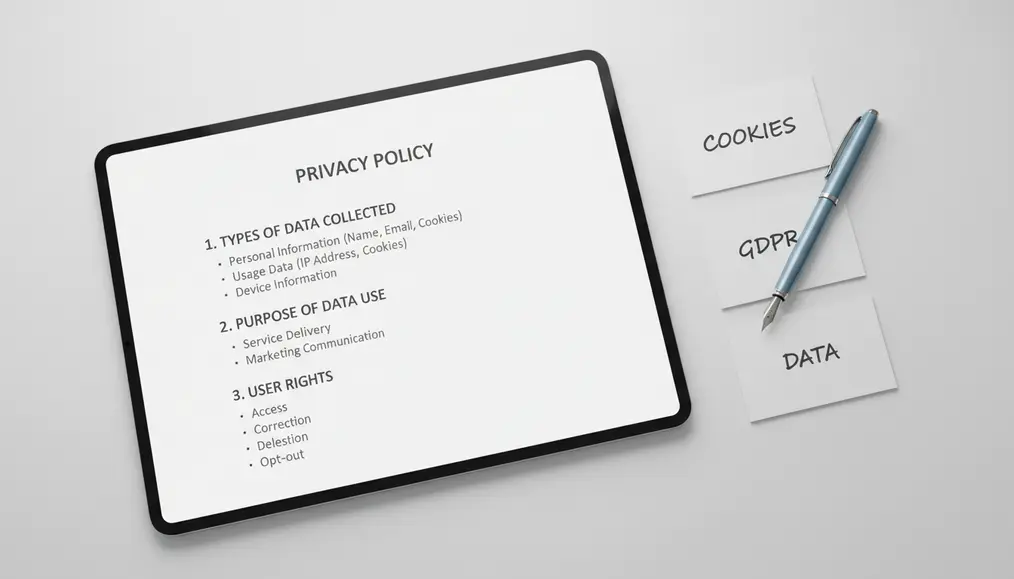
Understanding what to include in a privacy policy Australia is paramount. It's not enough to simply have a document; it must be comprehensive and clear, addressing specific requirements set out by the OAIC guidelines and the Australian Privacy Principles (APPs). Your privacy policy should, at a minimum, cover the following:
- Identity and Contact Details: Clearly state who you are and how users can contact you regarding privacy concerns.
- Types of Information Collected: Specify exactly what kind of personal information you collect (e.g., names, email addresses, phone numbers, IP addresses, browsing data, payment details).
- Purpose of Collection: Explain why you are collecting personal information. Is it for order processing, marketing, website improvement, or customer service? Be transparent about all uses.
- Disclosure to Third Parties: Detail any third parties with whom you share data, such as payment processors, analytics providers, marketing partners, or cloud hosting services. This is a critical aspect of data protection Australia.
- Overseas Disclosure: If you transfer personal information overseas, you must explicitly state this, including the countries and the steps taken to ensure data security.
- Data Security Measures: Describe the measures you have in place to protect the personal information you hold from misuse, interference, loss, unauthorised access, modification, or disclosure.
- Access and Correction: Inform users of their right to access and correct the personal information you hold about them.
- Complaints Process: Outline the process for individuals to make a complaint about a breach of the Australian Privacy Principles (APPs) and how you will deal with such complaints.
- Website Usage Data (Cookies): Explain your use of cookies and other tracking technologies, and how users can manage their preferences.
Each of these elements contributes to a robust Website privacy policy Australia, fostering trust and ensuring adherence to Australian privacy laws. For instance, clearly stating your cookie policy can significantly improve your online privacy Australia standing. Need guidance on structuring your site? Learn about Organising Your Website Pages So They Make Sense to Visitors, which includes where to place your privacy policy for easy access.
Consequences of Non-Compliance: Why Ignoring Your Privacy Policy is Risky

The consequences of no privacy policy Australia, or an inadequate one, can be severe. The OAIC has considerable powers to investigate complaints and impose significant penalties for breaches of the Privacy Act. Penalties for serious or repeated interferences with privacy can reach millions of dollars. For a body corporate, this can be up to $50 million, three times the value of any benefit obtained from the breach, or 30% of their adjusted turnover in the relevant period, whichever is the greatest. Beyond financial penalties, non-compliance can lead to reputational damage, loss of customer trust, and even business disruption. Customers are increasingly aware of their rights regarding online privacy Australia, and a lapse in data security can quickly lead to public backlash. An effective privacy policy is thus not merely a cost but an investment in your business's credibility and longevity. Moreover, considering the long-term value of your digital assets can be understood by Investing in Your Website: Understanding the Long-Term Value.
Navigating New Challenges: Data Breaches and ACCC Compliance
The landscape of data protection Australia is continually evolving. Mandatory data breach notification laws require entities to report eligible data breaches to the OAIC and affected individuals. This means that having strong data security measures and a clear incident response plan, often outlined or referenced in your privacy policy, is more critical than ever. Furthermore, the Australian Competition and Consumer Commission (ACCC) also has a role in protecting consumers, and misleading or deceptive conduct regarding privacy practices can fall under ACCC website compliance. This means that if your privacy policy makes promises about data handling that you do not uphold, you could face actions from the ACCC. Both the OAIC and ACCC work to ensure that businesses are transparent and responsible in their handling of consumer data, underscoring the importance of having your website privacy policy Australia up to scratch. Learning How to Write Website Text That Speaks to Your Australian Customers is also crucial for maintaining transparency.
Practical Steps to Ensure Your Privacy Policy is Compliant
For many businesses, particularly those asking "How to create a privacy policy for my website Australia" or "get a privacy policy for my website," the task can seem daunting. Here are some practical steps:
- Understand Your Data Flow: Conduct an internal audit to identify what personal information your website collects, why, how it's stored, and with whom it's shared. This is the first step towards achieving full website compliance.
- Consult the OAIC Guidelines: The OAIC website provides extensive resources and OAIC guidelines on the Australian Privacy Principles (APPs). Regularly review these to stay updated on privacy policy requirements.
- Develop or Update Your Policy: Draft your privacy policy based on your data practices and the privacy policy requirements. Ensure it is written in clear, plain language, avoiding jargon. For those wondering, "privacy policy generator Australia" tools can be a starting point, but customisation is always key.
- Seek Legal Advice: While this article provides general information, it is not legal advice. For specific, tailored guidance, especially regarding an Australian privacy policy template, consult legal professionals specializing in privacy law.
- Implement and Display: Once finalized, clearly display your privacy policy on your website. It should be easily accessible from every page, typically in the footer.
- Regular Reviews: Australian privacy laws and technology evolve. Regularly review and update your privacy policy (at least annually) to reflect changes in your data practices, technology, or legal requirements. This helps in maintaining ongoing website legal compliance and ensures you can always "check privacy policy compliance Australia" with confidence.
By proactively addressing these areas, you can significantly enhance your data protection Australia efforts and reassure users about their user data privacy. Moreover, integrating strong Protecting Your Site with Reliable Website Backups can add another layer of security for critical data.
Why choose Bornneo.Lab for Website privacy policy Australia?
- 🌟 Client-focused delivery with clear scope, timelines, and measurable outcomes aligned to your business goals.
- 🧩 End-to-end support from discovery and strategy to implementation, documentation, and handover.
- 📌 Practical solutions built to fit your existing stack and team workflow—no unnecessary complexity.
Conversion-Driven Design
We design digital experiences with a clear purpose. Every layout, interaction, and call-to-action is strategically crafted to guide users toward meaningful conversions—whether that means leads, sign-ups, or business inquiries.
Mobile-First & Responsive
With the majority of users accessing websites from mobile devices, we prioritize responsiveness from day one. Our solutions adapt seamlessly across screen sizes while maintaining performance and usability.
SEO & Performance Optimized
We build with technical SEO, site speed, and performance best practices in mind—helping your website earn visibility, trust, and sustainable organic growth.
Bornneo.Lab Client Testimonials
★★★★★ – Sarah L.: "Bornneo.Lab helped us craft a clear and compliant Website privacy policy Australia. Their team made a complex process straightforward, giving us peace of mind for our online business."
★★★★★ – David K.: "We were unsure about our privacy policy requirements for our new e-commerce site. Bornneo.Lab provided invaluable guidance and an effective solution for our ecommerce privacy policy Australia."
★★★★★ – Emily R.: "The expertise at Bornneo.Lab ensured our website met all Australian privacy laws. Their thorough approach to website legal compliance was exceptional."
★★★★★ – Mark T.: "Thanks to Bornneo.Lab, our small business privacy policy Australia is now fully compliant and easy to understand for our customers. They truly understand data protection Australia."
★★★★★ – Jessica P.: "Bornneo.Lab's support in developing our privacy policy was fantastic. They explained everything clearly, from OAIC guidelines to ensuring robust data security."
READ ALSO: How to Write Website Text That Speaks to Your Australian Customers
Frequently Asked Questions About Website Privacy Policies in Australia
1. What are the Australian Privacy Principles (APPs)?
The Australian Privacy Principles (APPs) are the cornerstone of Australian privacy laws, setting out standards, rights, and obligations for the handling of personal information by most Australian government agencies and private sector organizations. They cover the collection, use, disclosure, storage, and security of personal information, forming the basis of your website legal compliance and dictating privacy policy requirements.
2. How often should I update my Website privacy policy Australia?
It is recommended to review and update your Website privacy policy Australia at least annually, or whenever there are significant changes to your data handling practices, the types of data you collect, the services you use (e.g., new analytics tools or payment gateways), or changes in Australian privacy laws. Regular updates ensure ongoing website compliance and effective data protection Australia.
3. Can I just copy a privacy policy from another website?
No, simply copying a privacy policy from another website is not advisable. Each business has unique data collection practices, and a copied policy may not accurately reflect yours, leading to non-compliance and legal risks. While using an Australian privacy policy template or a "privacy policy generator Australia" can be a starting point, it's crucial to customize it to your specific operations to meet true privacy policy requirements and ensure proper user data privacy.
4. What is the role of the OAIC regarding privacy policies?
The Office of the Australian Information Commissioner (OAIC) is Australia's independent national privacy regulator. They are responsible for enforcing the Privacy Act, providing OAIC guidelines, handling complaints about privacy breaches, and promoting good privacy practices. The OAIC investigates non-compliance and can impose penalties, making adherence to their guidance critical for your Website privacy policy Australia. You can visit the OAIC website for comprehensive resources.
5. Do cookies and website analytics need to be mentioned in my privacy policy?
Yes, if your website uses cookies or third-party analytics tools (like Google Analytics) that collect personal information or track user behaviour, this absolutely needs to be disclosed in your privacy policy. You should explain what data is collected, its purpose, and how users can manage or opt-out of these technologies. This transparency is key to upholding online privacy Australia and effective user data privacy practices. The ACCC website also has resources concerning consumer data rights.
6. What should I do if my business has an eligible data breach?
If your business experiences an eligible data breach, meaning personal information held by your organization is lost or subjected to unauthorized access or disclosure, and it's likely to result in serious harm to the individuals concerned, you have mandatory notification obligations under Australian privacy laws. You must notify the OAIC and affected individuals as soon as practicable. Your privacy policy should ideally reference your commitment to managing data breaches and ensuring data security. For guidance on online safety and digital challenges, the eSafety Commissioner provides additional resources.
Contact Us
Ready to move forward with clarity and confidence? Get direct insights and tailored recommendations by speaking with our team.
Important Disclaimer
The information provided in this article is for general informational purposes only and does not constitute legal advice. While Bornneo.Lab aims to provide accurate and up-to-date content regarding web development best practices and compliance, readers should not rely solely on this information. It is essential to consult with a qualified legal professional for advice pertaining to your specific circumstances, particularly concerning Australian privacy laws, privacy policy requirements, and website legal compliance.