
_in_12_Weeks_in_AU.webp&w=1920&q=75)
In today's fast-paced digital landscape, getting your innovative idea to market quickly is paramount, especially for startups in Australia. The challenge often lies in proving your concept's viability without exhausting all your resources upfront. Many aspiring entrepreneurs grapple with the question of how to build a successful MVP in Australia efficiently, fearing lengthy development cycles and ballooning budgets.
The good news is that launching a functional, impactful product doesn't have to take years. With a focused approach and an experienced partner, you can navigate the complexities of the MVP development process and achieve a meaningful product launch in a remarkably short timeframe. This guide is designed to walk you through an accelerated MVP strategy, demonstrating how to build a Minimum Viable Product (MVP) in 12 Weeks in AU, tailored to the unique demands and opportunities of the Australian market.
At Bornneo.Lab, we understand the critical balance between speed and quality. Our goal is to equip you with the knowledge and actionable steps to turn your vision into a tangible product that resonates with early adopters, allowing for crucial market validation and iterative improvements. Let's delve into an MVP guide that prioritizes efficiency and strategic execution.
READ ALSO: Web Development for Startups: From MVP to Global Scale AU
Understanding the Core Principles of MVP Development in Australia

Before diving into the timeline, it's essential to grasp what a Minimum Viable Product truly is. An MVP isn't a stripped-down, buggy version of your ultimate product; it's the version of a new product which allows a team to collect the maximum amount of validated learning about customers with the least effort. This concept is central to the lean startup methodology, focusing on building, measuring, and learning. For a startup in Australia, this means identifying your value proposition and the core features that address a specific problem for your target audience.
The objective is to gather early user feedback to inform future development, ensuring you're building something people actually want and need. This minimizes risk and maximizes your chances of achieving product-market fit. Our approach to MVP development process emphasizes identifying the absolute essentials to solve a key problem, rather than trying to incorporate every possible feature from day one. This makes cost-effective MVP development a reality.
The 12-Week MVP Roadmap: A Phased Approach
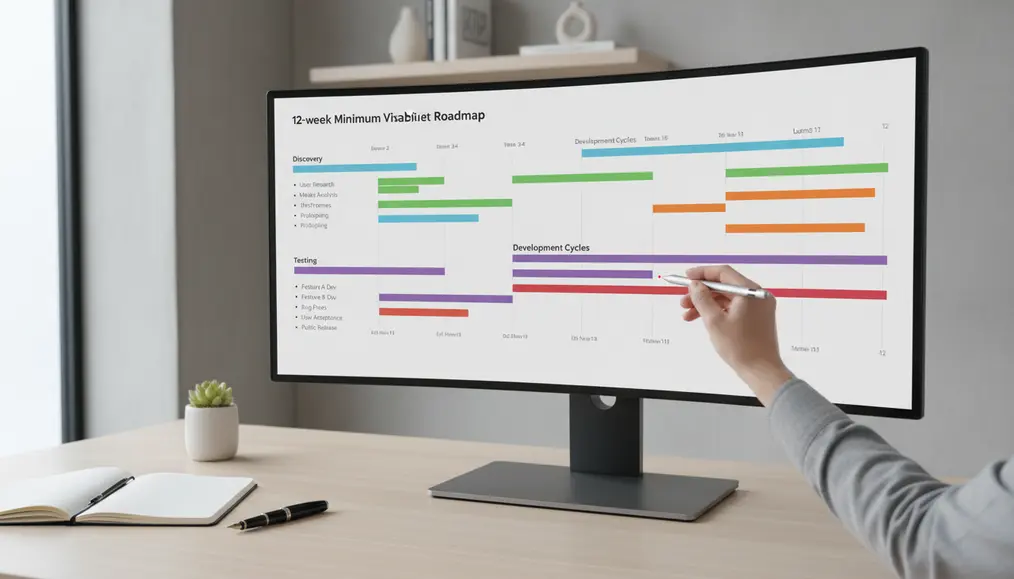
Successfully completing an MVP in 12 weeks requires discipline, clear communication, and a well-defined MVP roadmap Australia. Here’s a breakdown of the development timeline we recommend, broken into three distinct phases:
Phase 1: Weeks 1-4 – Discovery, Strategy & Planning
The initial four weeks are critical for laying a solid foundation. This is where we define the "what" and "why" of your startup MVP.
- Week 1: Vision & Goal Setting. We begin by deeply understanding your business goals, target audience, and the problem your product aims to solve. This involves workshops to define your value proposition and identify key success metrics. We establish clear objectives for the MVP development process to ensure everyone is aligned.
- Week 2: User Research & Feature Prioritization. Conducting preliminary market research specific to the Australian market helps validate assumptions. We'll identify your ideal user persona and map out their journey. Through techniques like feature storming and MoSCoW (Must-have, Should-have, Could-have, Won't-have) analysis, we pinpoint the core features absolutely necessary for your MVP, leaving out anything that doesn't directly contribute to the primary value proposition.
- Week 3: Technical Feasibility & Architecture. Our team assesses the technical feasibility of the chosen core features and begins designing the initial system architecture. This includes selecting the right technology stack that allows for rapid development and future scalability. This is a crucial step for building an MVP that is robust yet lean.
- Week 4: Scope Finalization & Project Plan. Based on the research and technical assessment, we finalize the MVP scope, create a detailed MVP plan, and outline the development timeline. This includes setting realistic expectations for the budget constraints and outlining potential risks. A clear MVP checklist is drafted for the subsequent phases.
Phase 2: Weeks 5-10 – Design & Development Sprint
This is where the magic happens, transforming concepts into a tangible product through an iterative development approach.
- Weeks 5-6: UI/UX Design & Prototyping. With the scope defined, our designers create wireframes and high-fidelity mockups for the user interface (UI) and user experience (UX). The focus is on intuitive design that simplifies user interaction, even with limited core features. A clickable prototype allows for early internal testing and refinement, ensuring the design aligns with the intended MVP strategy. Bornneo.Lab emphasizes Web Accessibility (WCAG 2.1) for AU Government & Public Sector, ensuring a broad user base can interact with your MVP.
- Weeks 7-8: Backend Development. Our developers begin building the foundational backend infrastructure, including databases, APIs, and server logic. This stage focuses on creating a stable, secure, and scalable core that supports the MVP's essential functionalities. Adopting MVP best practices here means building for future flexibility.
- Weeks 9-10: Frontend Development & Integration. The designed UI is brought to life with frontend development, making the product visually appealing and interactive. We integrate the frontend with the backend, ensuring seamless data flow and functionality. Regular internal testing occurs to catch and rectify issues quickly, adhering to the principles of iterative development.
Phase 3: Weeks 11-12 – Testing, Deployment & Launch Preparation
The final phase is about refining, validating, and preparing for your public debut.
- Week 11: Quality Assurance (QA) & Bug Fixing. Intensive testing is conducted across various devices and scenarios to identify and fix bugs, ensure responsiveness, and verify all core features function as intended. This includes functional testing, usability testing, and basic security checks. Receiving early user feedback from a small group during this stage can be invaluable.
- Week 12: Deployment & Final Preparations. The MVP is deployed to a live environment. We implement analytics tools to track user feedback and engagement metrics, which are crucial for subsequent iterations. Final checks are performed, and a soft product launch is executed to a limited audience for real-world market validation. This rapid approach ensures the benefits of rapid MVP development are realized quickly.
Key Considerations for Building an MVP in the Australian Market

While the general principles of MVP development process apply globally, there are specific nuances when you build MVP for the Australian market.
- Local Regulations and Compliance: Depending on your industry, you might need to consider local data privacy laws (like the Australian Privacy Act) or specific industry regulations right from the MVP stage. For instance, if your MVP touches on health, compliance with Medical Web Compliance: HIPAA & Australian Privacy Act Guide is crucial.
- Connectivity & Infrastructure: Australia's geographical vastness means internet speeds and access can vary. Ensuring your MVP is optimized for performance, even on slower connections, is an important MVP best practice. Focusing on Understanding Core Web Vitals for AU Search Rankings 2026 can enhance user experience.
- Cultural Nuances: Understanding local user preferences and behaviors can significantly impact your UI/UX design and messaging, ensuring your value proposition resonates effectively.
- Competitor Landscape: Researching existing solutions within the Australian market helps refine your unique selling proposition and ensures your MVP truly offers a differentiated value. This is part of identifying your product-market fit.
Overcoming Challenges in Your Accelerated MVP Strategy

An accelerated MVP strategy to build MVP in 12 weeks comes with its own set of challenges, particularly around budget constraints and managing scope creep.
- Scope Management: The biggest threat to hitting your 12-week target is feature creep. Stick rigorously to your defined core features and remember that "minimum" is key. Anything beyond the essential value proposition should be deferred to later iterations. This discipline is a cornerstone of cost-effective MVP development.
- Resource Allocation: Ensure you have a dedicated, cohesive team. For many startups, this means partnering with an external team like Bornneo.Lab who can provide concentrated expertise without the overheads of hiring a full in-house team immediately. Our expertise in MVP development process helps maintain focus and efficiency.
- Communication: Transparent and frequent communication between all stakeholders is vital. Daily stand-ups and weekly progress reviews keep everyone on the same page and allow for quick problem-solving, crucial for maintaining the development timeline.
- Realistic Expectations: While the goal is rapid development, it's important to understand that an MVP is a starting point, not a finished product. Its purpose is to learn and validate. Embrace iterative development and be prepared to pivot based on user feedback and market validation.
Why choose Bornneo.Lab for MVP development process?
- 🌟 Client-focused delivery with clear scope, timelines, and measurable outcomes aligned to your business goals.
- 🧩 End-to-end support from discovery and strategy to implementation, documentation, and handover.
- 📌 Practical solutions built to fit your existing stack and team workflow—no unnecessary complexity.
Conversion-Driven Design
We design digital experiences with a clear purpose. Every layout, interaction, and call-to-action is strategically crafted to guide users toward meaningful conversions—whether that means leads, sign-ups, or business inquiries.
Mobile-First & Responsive
With the majority of users accessing websites from mobile devices, we prioritize responsiveness from day one. Our solutions adapt seamlessly across screen sizes while maintaining performance and usability.
SEO & Performance Optimized
We build with technical SEO, site speed, and performance best practices in mind—helping your website earn visibility, trust, and sustainable organic growth.
Bornneo.Lab Client Testimonials
★★★★★ – Sarah L.: "Bornneo.Lab helped us define our startup MVP and brought it to life faster than we imagined. Their approach to the MVP development process was incredibly efficient."
★★★★★ – David K.: "We needed to build MVP for the Australian market quickly and cost-effectively. Bornneo.Lab delivered a high-quality product right on schedule, enabling us to get crucial user feedback."
★★★★★ – Emily R.: "The team's expertise in lean startup methodology was evident throughout. They kept us focused on core features and delivered an amazing product launch within the 12-week timeframe."
★★★★★ – Mark T.: "Their MVP strategy was clear and effective. Bornneo.Lab understood our budget constraints and helped us achieve market validation without overspending."
★★★★★ – Jessica P.: "From an initial idea to a fully functional product, Bornneo.Lab guided us through every step. Their MVP guide and detailed development timeline made the entire process seamless."
Conclusion: Your Fast Track to Market Validation in AU
Embarking on the journey to build a Minimum Viable Product (MVP) in 12 Weeks in AU is an ambitious yet entirely achievable goal with the right approach and a dedicated team. By adhering to a structured MVP roadmap Australia, prioritizing core features, and embracing iterative development, you can effectively manage budget constraints and achieve a rapid product launch.
The benefits of rapid MVP development extend beyond just speed; it allows for early market validation, gathering vital user feedback, and making data-driven decisions for future iterations. This focused MVP development process is not just about building a product; it's about building a sustainable business. By partnering with an experienced web development team like Bornneo.Lab, you gain a strategic advantage in navigating the complexities of the Australian market and transforming your innovative idea into a tangible success. Our commitment to MVP best practices ensures your path to product-market fit is as smooth and efficient as possible.
READ ALSO: SSR vs SSG: Choosing the Best Rendering Strategy for AU SEO
Frequently Asked Questions about MVP Development in AU
Q1: What exactly is a Minimum Viable Product (MVP) in the context of a 12-week timeline?
A1: In a 12-week timeline, an MVP is the version of your product with just enough core features to satisfy early customers and provide market validation. It's designed to solve a primary problem, collect maximum user feedback with minimal effort, and test your fundamental value proposition. The goal is a rapid product launch to quickly learn from real users, not a fully-featured product. This adheres to the lean startup methodology and ensures cost-effective MVP development.
Q2: How do I ensure my MVP will be relevant to the Australian market?
A2: Ensuring relevance to the Australian market involves several steps within your MVP development process. Firstly, conduct initial user research and competitor analysis focusing specifically on Australian demographics, preferences, and existing solutions. Secondly, incorporate local nuances into your UI/UX design and content. Finally, consider any specific local regulations or cultural aspects relevant to your product. An effective MVP roadmap Australia will integrate these considerations from the outset to achieve optimal product-market fit.
Q3: What are the typical budget constraints for building an MVP in 12 weeks in Australia?
A3: Budget constraints for an MVP in 12 weeks in Australia can vary significantly based on complexity, technology stack, and team size. However, the very nature of an MVP is to be cost-effective MVP development. By rigorously prioritizing core features and following an accelerated MVP strategy, you reduce development hours and infrastructure costs. Engaging with an experienced team like Bornneo.Lab helps optimize your budget by providing clear scope definition and efficient execution throughout the development timeline, avoiding unnecessary expenses and focusing on the most critical aspects of your MVP plan.
Q4: Can an existing business benefit from an MVP, or is it just for startups?
A4: While the term startup MVP is common, existing businesses can significantly benefit from applying the MVP development process for new features, product lines, or internal tools. It allows them to test new ideas, gauge demand, and gather user feedback without committing extensive resources to a full-scale launch. This iterative development approach helps established companies innovate, adapt to market changes, and maintain a competitive edge, ensuring efficient resource allocation and continued market validation in the Australian market.
Contact Us
Ready to move forward with clarity and confidence? Get direct insights and tailored recommendations by speaking with our team.
Disclaimer
The information provided in this article is for general informational purposes only and does not constitute technical, business, or investment advice. While we strive to provide accurate and up-to-date content, readers should consult with qualified experts for advice tailored to their specific situation. Bornneo.Lab does not guarantee the success or outcome of any project based on the information presented herein.
About Bornneo.Lab
Bornneo.Lab is a trusted digital agency specializing in web development and innovative digital solutions for businesses across Australia. With a focus on strategic planning, cutting-edge technology, and user-centric design, we partner with startups and established enterprises to deliver high-performance, scalable, and impactful online experiences. From crafting robust MVPs to developing complex platforms, our team is dedicated to turning your vision into a successful digital reality.
```