
In today's digital age, government and public sector websites serve as critical gateways to essential information and services for all citizens. Yet, many still face barriers that exclude a significant portion of the population. We're talking about individuals with disabilities who often struggle to navigate non-accessible digital platforms. This isn't just about good practice; it's a fundamental issue of equity and legal obligation, particularly in Australia.
The Australian government and public sector have a clear mandate to ensure their digital offerings are usable by everyone. This commitment is underpinned by the Disability Discrimination Act (DDA) 1992, which strongly advocates for `digital inclusion Australia`. Central to achieving this goal is adherence to the Web Content Accessibility Guidelines (WCAG) 2.1, which provides a globally recognized framework for Web accessibility Australia. Ignoring these guidelines can lead to reputational damage, legal challenges, and, most importantly, disenfranchisement of citizens who rely on these services.
As a leader or decision-maker in the AU government accessibility space, understanding and implementing Web Accessibility (WCAG 2.1) for AU Government & Public Sector is not merely a technical task but a strategic imperative. It ensures that your services are truly universal, fostering trust and enabling greater participation across the community. Bornneo.Lab specializes in guiding Australian government and public sector entities through this complex landscape, ensuring your digital presence is inclusive, compliant, and impactful.
READ ALSO: Custom Enterprise Web Development: Scaling for AU Corporates
Understanding WCAG 2.1 and its Significance for AU Public Sector

The Web Content Accessibility Guidelines (WCAG) 2.1 is an internationally recognized standard developed by the World Wide Web Consortium (W3C). It outlines a comprehensive set of recommendations for making web content more accessible to people with disabilities. For the AU government accessibility and `public sector WCAG`, this standard is not just a recommendation but a foundational requirement. It directly supports the spirit and intent of the `disability discrimination act web` (DDA) 1992, which makes it unlawful to discriminate against people with disabilities. Therefore, every government agency and public sector body in Australia has `legal obligations for accessible websites AU`.
The DDA doesn't explicitly name WCAG, but the Australian Human Rights Commission (AHRC) has consistently referenced WCAG as the benchmark for achieving non-discriminatory online services. This means that failing to meet these guidelines could lead to formal complaints and legal action. Beyond legalities, the ethical drive towards `digital inclusion Australia` is paramount. Public services are meant for everyone, and digital platforms should reflect that universal access. By adhering to `WCAG 2.1 guidelines AU`, government agencies ensure that individuals with visual, auditory, physical, speech, cognitive, language, learning, and neurological disabilities can access and interact with essential information and services independently. This isn't just about compliance; it's about building a truly equitable society. To understand the broader impact of such specialized web solutions, you might find insights on Industry-Specific Web Solutions: Healthcare, Edu & Real Estate AU helpful.
The Core Principles of WCAG 2.1: POUR
WCAG 2.1 is structured around four fundamental principles, often remembered by the acronym POUR:
- Perceivable: Information and user interface components must be presentable to users in ways they can perceive. This means providing text alternatives for non-text content, captions for audio/video, and ensuring content can be presented in different forms (e.g., larger text, simpler layout) without losing information. For instance, an image on a government services page explaining a new policy must have descriptive alt text so screen reader users can understand its context.
- Operable: User interface components and navigation must be operable. This includes ensuring all functionality is available via keyboard, providing enough time for users to read and use content, and avoiding content that causes seizures. A crucial aspect for `web accessibility Australia` in government sites is ensuring complex online forms can be completed entirely with a keyboard, without relying on mouse input.
- Understandable: Information and the operation of the user interface must be understandable. This involves making text readable and understandable, making web pages appear and operate in predictable ways, and helping users avoid and correct mistakes. Clear language in government advisories and consistent navigation across all pages are key examples.
- Robust: Content must be robust enough that it can be interpreted reliably by a wide variety of user agents, including assistive technologies. This means using clean, semantic HTML, ensuring compatibility with current and future user agents. For example, a `public sector WCAG` compliant website should function correctly across various browsers and assistive technologies like screen readers, ensuring everyone can access the information regardless of their chosen tools.
Navigating WCAG 2.1 Requirements for Australian Government Websites
For `AU government accessibility`, the general expectation is to meet WCAG 2.1 Level AA. While Level AAA offers the highest level of accessibility, it's often not feasible for all content due to practical constraints. Level AA strikes a balance, providing significant improvements in accessibility without imposing an unreasonable burden on content creators and developers. Meeting these `WCAG 2.1 requirements for Australian government websites` involves addressing numerous success criteria across the POUR principles.
Specific examples of `WCAG 2.1 guidelines AU` that are critical for government sites include:
- Text Alternatives (1.1.1 Non-text Content): All images, icons, and non-text elements must have accurate and concise alt text. This is fundamental for screen reader users accessing government reports or infographics.
- Keyboard Navigation (2.1.1 Keyboard): Every interactive element – links, buttons, form fields – must be operable using only a keyboard. This is vital for users with motor impairments who cannot use a mouse. Imagine trying to lodge a tax return if the submit button isn't keyboard navigable.
- Headings and Labels (2.4.6 Headings and Labels): Headings should clearly describe the topic or purpose of the section, and form labels should be descriptive and correctly associated with their input fields. This aids navigation for everyone, especially those using screen readers.
- Contrast (1.4.3 Contrast Minimum): Text and image of text must have a contrast ratio of at least 4.5:1, ensuring readability for users with low vision. Government websites often contain critical information, so high contrast is essential.
- Language Identification (3.1.1 Language of Page): The human language of each web page must be identified programmatically. This allows screen readers to switch pronunciation, improving comprehension.
- Error Identification (3.3.1 Error Identification): If an input error is detected, the item in error must be identified, and the error described to the user in text. This is crucial for online application forms.
- Document Accessibility: PDFs and other downloadable documents common on government sites must also be accessible, with proper tagging, reading order, and alt text for images.
- Media Accessibility: Any video or audio content must include captions, transcripts, and potentially audio descriptions. This ensures `web accessibility for people with disabilities Australia` who are deaf, hard of hearing, or visually impaired can access important public announcements or educational content.
Meeting these standards requires a comprehensive approach, from design and development to content creation and ongoing maintenance. This is where `web accessibility consulting Australia` becomes invaluable, offering expertise to seamlessly integrate these requirements into your existing systems. Services such as Legacy System Modernisation: Tech Refresh for AU Businesses can be particularly useful when dealing with older government platforms that predate modern accessibility standards.
The Imperative of Digital Inclusion: Beyond Compliance

While `web compliance AU` with WCAG 2.1 Level AA is a legal necessity for government and public sector entities, the real value of achieving Web accessibility Australia extends far beyond simply avoiding penalties. It's about fostering genuine `digital inclusion Australia` and unlocking significant benefits for both the government and its citizens.
The `benefits of WCAG compliance for public sector` are multifaceted:
- Expanded Reach and Service Delivery: An accessible website ensures that crucial government services and information reach the widest possible audience. This includes people with disabilities, seniors, individuals in rural areas with limited internet access, and even those using older technology. For example, an accessible electoral commission website ensures all eligible citizens can register to vote or understand election procedures.
- Enhanced User Experience for Everyone: Many accessibility features benefit all users. Clear navigation, well-structured content, high contrast, and keyboard operability make a website easier to use for everyone, not just those with disabilities. This leads to reduced frustration and more efficient interaction with government services.
- Reduced Legal and Reputational Risk: Proactive `achieve WCAG compliance` significantly mitigates the risk of `disability discrimination act web` complaints and subsequent legal action. Beyond legal costs, negative publicity from an inaccessible website can severely damage public trust and confidence in a government agency.
- Improved SEO and Performance: Many accessibility best practices, such as semantic HTML, clear content structure, and proper use of headings, also contribute positively to search engine optimization (SEO). This means accessible websites are often more discoverable, helping citizens find the information they need faster.
- Economic Benefits: By enabling more citizens to access and utilize online government services, agencies can see reduced calls to support centres and less need for in-person assistance, leading to operational efficiencies and cost savings.
Ultimately, investing in `accessible website development` means building a public sector that truly serves all Australians. It reinforces the values of equality, fairness, and universal access, which are central to a functioning democracy. This commitment to inclusivity is a hallmark of responsible governance, ensuring that no citizen is left behind in the digital transformation journey. Bornneo.Lab champions this holistic approach, understanding that effective `bornneo.lab accessibility` solutions are about empowering communities.
Practical Steps to Implement Web Accessibility AU
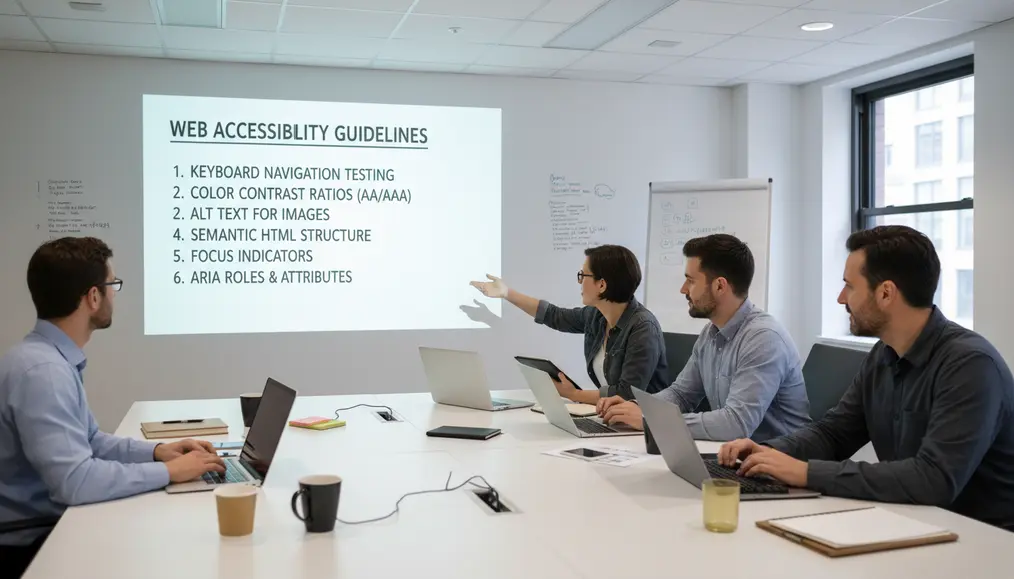
To effectively `implement web accessibility AU` for government and public sector websites, a structured approach is crucial. This isn't a one-time fix but an ongoing commitment requiring integration into every stage of the web development lifecycle.
- Conduct a Comprehensive Accessibility Audit: The first step is to understand your current baseline. An experienced `web accessibility consulting Australia` firm like Bornneo.Lab can perform a detailed audit of your existing website against `WCAG 2.1 guidelines AU` (targeting Level AA). This involves both automated testing tools and crucial manual testing by experts familiar with various assistive technologies. The audit identifies specific issues and provides a roadmap for remediation.
- Integrate Accessibility from Design Onset: For new projects or redesigns, `accessible website development` must start at the wireframing and design phase. This includes considerations for colour contrast, clear visual hierarchy, intuitive navigation, and user flow. Designers should be trained in accessibility principles to prevent issues from propagating into development.
- Develop with Accessibility in Mind: Developers must use semantic HTML, ARIA attributes correctly, and ensure full keyboard operability. Front-end frameworks and libraries should be chosen with their accessibility features in mind. Ensuring proper `web accessibility for people with disabilities Australia` often means rigorous testing throughout the development cycle.
- Create Accessible Content: Content creators play a vital role. This includes writing clear and concise language, providing descriptive alt text for images, creating accurate captions and transcripts for multimedia, and ensuring documents (like PDFs) are properly tagged and structured. Government publications, often rich in data, require particular attention to be `public sector WCAG` compliant.
- Ongoing Monitoring and Maintenance: Accessibility is not a 'set it and forget it' task. Websites evolve, and new content is constantly added. Regular accessibility scans, periodic audits, and continuous training for content managers and developers are essential to maintain `WCAG 2.1 requirements for Australian government websites`.
- User Testing with People with Disabilities: The most valuable insights come directly from the target users. Engaging individuals with various disabilities to test your website provides real-world feedback and helps uncover issues that automated tools might miss.
By following these steps, government agencies can systematically `achieve WCAG compliance` and ensure their digital presence is truly inclusive. This proactive approach not only addresses `legal obligations for accessible websites AU` but also enhances the overall quality and usability of your digital services for everyone. Bornneo.Lab offers end-to-end support for these initiatives, from initial strategy to deployment and beyond, ensuring a smooth transition to an accessible future. For complex system integration, insights from API-First Development: Connecting Your AU Business Ecosystem can be invaluable.
Common Challenges in Achieving WCAG Compliance for Government Sites
While the commitment to Web accessibility Australia is strong within the public sector, several common challenges can impede the journey towards full `WCAG 2.1 compliance`. Understanding these hurdles is the first step towards overcoming them effectively.
- Legacy Systems and Technical Debt: Many government websites have been built over years, often on older platforms and with outdated coding practices. Modernising these `legacy system modernisation: tech refresh for au businesses` to meet current accessibility standards can be complex, time-consuming, and resource-intensive. Rebuilding or significantly overhauling such systems requires careful planning and a phased approach. Bornneo.Lab has extensive experience in Legacy System Modernisation: Tech Refresh for AU Businesses, specifically tailored to the Australian context, making us a key partner in addressing this challenge.
- Budget and Resource Constraints: Public sector bodies often operate under strict budget limitations. Allocating sufficient funds and dedicated personnel for accessibility initiatives can be a challenge, especially when competing with other critical projects. Demonstrating the long-term `benefits of WCAG compliance for public sector` can help secure the necessary investment.
- Lack of Awareness and Training: A common barrier is the lack of comprehensive understanding of `WCAG 2.1 guidelines AU` across all roles – from content creators and designers to developers and project managers. Without adequate training, accessibility can be seen as an afterthought or an external audit requirement rather than an integral part of the development process.
- Complex Content and Data Visualisation: Government websites frequently deal with vast amounts of complex information, including detailed reports, data visualisations, and interactive maps. Making this intricate content accessible, especially for users relying on screen readers, presents unique `WCAG 2.1 requirements for Australian government websites` that demand specialized expertise.
- Third-Party Integrations: Government sites often integrate with third-party applications or services (e.g., payment gateways, mapping services). Ensuring the accessibility of these external components is crucial but can be outside the direct control of the agency, posing a significant challenge for overall `web compliance AU`.
- Maintaining Accessibility Post-Launch: Even after achieving initial compliance, new content, updates, and system changes can inadvertently introduce accessibility barriers. Continuous monitoring, regular audits, and robust internal processes are essential to maintain `AU government accessibility` over time.
Addressing these challenges requires a strategic, organisation-wide commitment and often the guidance of experienced `web accessibility consulting Australia` firms. Bornneo.Lab understands these complexities and works collaboratively with government agencies to develop tailored strategies that overcome these obstacles, ensuring a sustainable path to `digital inclusion Australia`.
Bornneo.Lab's Approach to WCAG Compliance for Australian Public Sector
At Bornneo.Lab, we understand the critical importance of `WCAG 2.1 guidelines AU` for AU government accessibility and the unique challenges faced by the public sector in Australia. Our approach to `bornneo.lab accessibility` is rooted in a deep understanding of both technical requirements and the specific context of public service delivery. We partner with government agencies and public sector bodies to not just meet but exceed their `legal obligations for accessible websites AU`, fostering genuine `digital inclusion Australia`.
Our experienced team provides comprehensive services designed to help you `achieve WCAG compliance` efficiently and effectively:
- Accessibility Audits and Roadmaps: We start with thorough audits of your existing digital platforms, meticulously evaluating them against `WCAG 2.1 requirements for Australian government websites` at Level AA. This results in a clear, actionable roadmap outlining specific issues and pragmatic solutions for remediation.
- `Accessible Website Development` and Redesign: Whether you're building a new platform or revitalising an existing one, we embed accessibility throughout the entire design and development lifecycle. Our developers are adept at implementing semantic HTML, ARIA, and other techniques to ensure `web accessibility for people with disabilities Australia` from the ground up.
- Content Accessibility Guidance: We provide training and best practices for your content teams, ensuring all new and existing content – including text, images, videos, and documents – is created with `public sector WCAG` in mind.
- Ongoing Support and Monitoring: Accessibility is an ongoing commitment. We offer continuous monitoring, regular testing, and support services to ensure your website remains compliant as it evolves and new content is added. This proactive approach helps maintain your `web compliance AU` status without disruption.
- Strategic Consulting: Our `web accessibility consulting Australia` services extend beyond technical implementation. We help you develop a long-term accessibility strategy that aligns with your organisational goals and promotes a culture of `digital inclusion Australia`.
By partnering with Bornneo.Lab, you gain a trusted ally committed to ensuring your digital services are accessible to every citizen. We leverage our expertise to transform complex `WCAG 2.1 guidelines AU` into practical, implementable solutions, making your Web accessibility Australia journey smooth and successful.
Why choose Bornneo.Lab for Web accessibility Australia?
- 🌟 Client-focused delivery with clear scope, timelines, and measurable outcomes aligned to your business goals.
- 🧩 End-to-end support from discovery and strategy to implementation, documentation, and handover.
- 📌 Practical solutions built to fit your existing stack and team workflow—no unnecessary complexity.
Conversion-Driven Design
We design digital experiences with a clear purpose. Every layout, interaction, and call-to-action is strategically crafted to guide users toward meaningful conversions—whether that means leads, sign-ups, or business inquiries.
Mobile-First & Responsive
With the majority of users accessing websites from mobile devices, we prioritize responsiveness from day one. Our solutions adapt seamlessly across screen sizes while maintaining performance and usability.
SEO & Performance Optimized
We build with technical SEO, site speed, and performance best practices in mind—helping your website earn visibility, trust, and sustainable organic growth.
Bornneo.Lab Client Testimonials
★★★★★ – David Chen: Bornneo.Lab helped us navigate the complex WCAG 2.1 requirements for our government portal, delivering a site that is not only compliant but genuinely user-friendly for all our citizens. Their expertise in Web accessibility Australia is unmatched.
★★★★★ – Sarah Kim: Our public sector agency needed to overhaul its website to meet current accessibility standards. Bornneo.Lab provided an excellent strategy and execution, making our services truly accessible and reducing our legal exposure. Highly recommend their `bornneo.lab accessibility` services.
★★★★★ – Michael O'Connell: The team at Bornneo.Lab made achieving `WCAG 2.1 compliance` for our educational platform a seamless process. They understood our unique needs as an AU institution and delivered an outstanding, inclusive digital experience.
★★★★★ – Emily R.: We engaged Bornneo.Lab for `web accessibility consulting Australia` and were impressed by their detailed audit and clear remediation plan. Their insights were invaluable in transforming our website into a truly `accessible website development` example.
★★★★★ – John Davies: Bornneo.Lab's support in ensuring our local council website met `AU government accessibility` standards was exceptional. They provided practical solutions that were easy to implement, greatly enhancing our `digital inclusion Australia` efforts.
READ ALSO: High-Performance Property Portals for AU Real Estate Agencies
Frequently Asked Questions About Web Accessibility (WCAG 2.1) for AU Government & Public Sector
Is WCAG 2.1 legally binding for AU government and public sector websites?
While the Australian Disability Discrimination Act (DDA) 1992 doesn't explicitly name WCAG 2.1, the Australian Human Rights Commission (AHRC) consistently references WCAG as the benchmark for non-discriminatory online services. Therefore, compliance with `WCAG 2.1 guidelines AU` is effectively a legal requirement to meet your `legal obligations for accessible websites AU` and avoid discrimination claims under the DDA. Failing to `implement web accessibility AU` puts government and public sector entities at risk.
What level of WCAG compliance is generally required for AU government accessibility?
For `AU government accessibility` and the public sector, the widely accepted and recommended target is WCAG 2.1 Level AA. While Level AAA offers the highest degree of accessibility, Level AA strikes a practical balance, providing substantial improvements for users with disabilities while being achievable for most web content. Bornneo.Lab specializes in helping clients `achieve WCAG compliance` at this crucial level for `public sector WCAG` requirements.
How long does it take to implement web accessibility AU for an existing government website?
The timeline to `implement web accessibility AU` can vary significantly. It depends on the size and complexity of your existing website, its current level of accessibility, the resources available, and the volume of content. A comprehensive audit is the first step, providing a detailed roadmap and estimated timeline. Bornneo.Lab works to make this process as efficient as possible, providing tailored `web accessibility consulting Australia` to minimise disruption and ensure effective remediation.
What are the first steps for a government agency looking to improve its WCAG compliance?
The immediate first step is to conduct an initial accessibility audit of your website to identify current barriers and determine your baseline compliance level against `WCAG 2.1 requirements for Australian government websites`. Following this, developing a strategic plan for remediation and ongoing maintenance, coupled with educating internal teams on `accessible website development` best practices, is crucial. Partnering with an experienced firm like Bornneo.Lab for this initial audit and strategy development can provide clear direction and accelerate your `web accessibility Australia` journey.
Can Bornneo.Lab help with an existing, non-compliant government website?
Absolutely. Bornneo.Lab specialises in helping government and public sector entities address accessibility issues on existing websites. Our `bornneo.lab accessibility` services include detailed audits, strategic planning for remediation, and the technical implementation required to bring your site up to `web compliance AU` with WCAG 2.1 Level AA. We understand the complexities of `legacy system modernisation: tech refresh for au businesses` and can provide effective, practical solutions.
Contact Us
Ready to move forward with clarity and confidence? Get direct insights and tailored recommendations by speaking with our team.
Disclaimer
The information provided in this article is for general informational purposes only and does not constitute legal advice. While Bornneo.Lab strives to provide accurate and up-to-date content, web accessibility standards and legal requirements, including those pertaining to Web accessibility Australia and `WCAG 2.1 guidelines AU`, are subject to change. Government agencies and public sector entities should consult with legal experienced and accessibility experts to ensure full compliance with all applicable laws and regulations.