

In Australia's dynamic digital landscape, choosing the right e-commerce platform isn't just a technical decision—it's a strategic one that can define your brand's future. For many businesses, the debate often boils down to a critical choice: Headless commerce vs Shopify. Both offer powerful capabilities for launching and managing an online retail AU presence, yet they cater to very different needs and aspirations. Understanding these differences is crucial, especially as your AU brand grows and seeks to differentiate itself in a competitive market.
As your business evolves, so too should your digital storefront. Are you aiming for rapid deployment with minimal fuss, or do you envision a highly customised, future-proof experience that can seamlessly integrate with a myriad of services? This isn't just about picking a tool; it's about aligning your technology with your long-term vision, customer experience goals, and operational realities. Let's delve into the nuances of Headless commerce vs Shopify to help you determine which path is best suited for your ambitions in the Australian market.
READ ALSO: Optimising E-commerce Page Speed for Better AU Conversion Rates
Understanding the Core: What Each Platform Offers
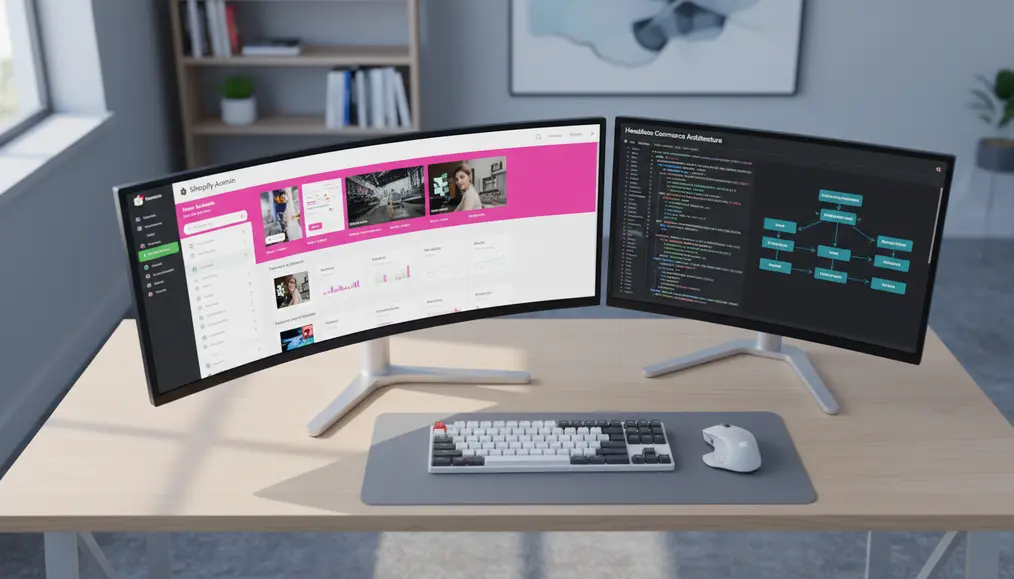
Before we dive into a direct comparison, it's essential to grasp the fundamental nature of each approach. The term "e-commerce architecture Australia" encompasses various models, and Shopify platform and headless commerce represent two distinct philosophies in how an online retail AU business constructs its digital storefront.
Shopify: The Integrated Solution
The Shopify platform operates as a Software-as-a-Service (SaaS) solution, renowned for its all-in-one approach. It provides everything an online retail AU business needs to get started: hosting, payment processing, inventory management, a content management system, and a front-end theme system, all bundled together. For many, it's the go-to for quick setup and ease of use, making it an attractive option for businesses looking for straightforward e-commerce solutions.
Headless Commerce: The Decoupled Approach
Headless commerce, in contrast, is an approach where the front-end (what your customers see and interact with) is decoupled from the back-end (the engine that handles product data, orders, and payments). The "head" (front-end) is removed, allowing developers to build entirely custom digital storefront experiences using any technology stack, while the "body" (back-end) handles the core commerce functionalities, exposed via APIs. This distinction is critical when considering the long-term e-commerce strategy Australia for a growing brand.
Shopify: The All-in-One Powerhouse for Australian Businesses

The Shopify platform has carved a significant niche in the online retail AU market, particularly for small to medium-sized businesses and startups. Its appeal lies in its simplicity and comprehensive feature set, enabling rapid deployment and management of a digital storefront without extensive technical knowledge.
Key Strengths of Shopify for the AU Market
- Ease of Use & Speed to Market: One of Shopify's biggest drawcards is its user-friendly interface. Businesses can launch a fully functional digital storefront in a matter of days or weeks, making it ideal when to choose Shopify for your AU online store if time is of the essence.
- Integrated Ecosystem: Shopify boasts a vast app store, offering extensions for everything from marketing to shipping and customer service. This allows for quick scaling of functionality without custom development, streamlining operations for online retail AU businesses.
- Security and Reliability: As a SaaS platform, Shopify handles all hosting, security updates, and maintenance. This offloads significant technical burden from merchants, ensuring a stable and secure shopping environment, which is vital for building trust with Australian consumers.
- Built-in Payment Gateways: Shopify Payments offers competitive rates and seamless integration, simplifying transaction processing for businesses operating in Australia, including local currency support and tax calculations.
For brands seeking a robust, out-of-the-box solution with strong support and a rich feature set, the Shopify platform remains a top contender among e-commerce solutions. It’s particularly strong for those who want to focus on sales and marketing rather than complex infrastructure management.
Headless Commerce: Unlocking Customisation and Scalability for AU Growth

For Australian brands that have outgrown the confines of traditional monolithic platforms or those with ambitious visions for unique customer experiences, headless commerce offers a compelling alternative. It represents a paradigm shift in e-commerce architecture Australia, prioritising flexibility and innovation.
Unpacking the Advantages of Headless for AU E-commerce
- Unparalleled Frontend Freedom: This is arguably the biggest advantage. With headless commerce, businesses have complete control over their digital storefront design and user experience. Developers can use modern frameworks like React, Vue.js, or Angular to create highly engaging, lightning-fast interfaces. This enables truly custom storefront development AU that reflects specific brand identities and customer journeys.
- Superior Performance: Decoupling the front-end allows for significant performance gains. Custom frontends can be highly optimised for speed and responsiveness, directly impacting user experience and SEO. Faster loading times lead to better conversion rates and improved search engine rankings, which are critical for any e-commerce strategy Australia. You can even consider how AI agents might enhance customer support (Agentic AI for Customer Support: Moving Beyond Simple Chatbots) within this flexible architecture.
- Omnichannel Capabilities: Headless commerce makes it easier to deliver consistent experiences across multiple channels—web, mobile apps, IoT devices, social commerce, and even in-store digital displays. This unified approach is a significant benefit of composable commerce advantages, allowing brands to meet customers wherever they are.
- Future-Proofing: By separating concerns, businesses can update their front-end or back-end independently. This agility allows for rapid adoption of new technologies and trends, effectively future-proofing e-commerce investments. If a new payment method or display technology emerges, a headless setup can adapt much faster without overhauling the entire system.
- Seamless Integrations: The API-first nature of headless commerce facilitates easy integration with a wide array of third-party services, including advanced CRMs, ERPs, PIMs, and marketing automation tools. This addresses potential Shopify Plus limitations regarding highly specific or complex system integrations, allowing for robust `integrating headless with existing systems Australia`.
The benefits of headless commerce for Australian businesses are clear for those prioritising unique branding, performance, and long-term scalability. It’s about building a tailored environment that truly supports an ambitious e-commerce strategy Australia.
The Critical Comparison: Headless Commerce vs Shopify for Your AU Brand

Now that we've explored each option, let's put them side-by-side to clarify the choice between Headless commerce vs Shopify for your AU brand.
Flexibility and Customisation
- Shopify: Offers significant customisation within its theme architecture and app ecosystem. However, fundamental changes to the checkout flow or highly unique user experiences can be restricted, potentially revealing Shopify Plus limitations for brands pushing creative boundaries.
- Headless Commerce: Provides unlimited flexibility. You build the front-end from scratch, allowing for any design, interaction, or integration imaginable. This is where custom storefront development AU truly shines.
Performance
- Shopify: Generally performs well, but as a multi-tenant SaaS, performance can be influenced by shared infrastructure. Optimising your site for performance (like Optimising E-commerce Page Speed for Better AU Conversion Rates) is possible, but there are inherent limits.
- Headless Commerce: Often delivers superior performance due to custom, highly optimised front-ends, leading to faster page loads and smoother user experiences. This is a key part of composable commerce advantages.
Scalability
- Shopify: Highly scalable for most businesses, with Shopify Plus catering to enterprise-level needs. However, for extremely high traffic or complex, global operations, some businesses might experience Shopify disadvantages for scale AU, particularly regarding integration complexity or unique performance demands.
- Headless Commerce: Designed for ultimate scalability. You can independently scale front-end and back-end resources, making it excellent for dealing with fluctuating traffic and expanding into new markets. Consider this for `Shopify vs headless for scaling in Australia`.
Development & Maintenance Costs
- Shopify: Lower initial setup cost and ongoing subscription fees. Maintenance is largely handled by Shopify. However, app subscriptions and custom theme development can add up.
- Headless Commerce: Higher initial development cost due to the need for custom front-end development and integration work. Ongoing maintenance can also be higher as it requires more specialised expertise. Understanding the `cost of headless commerce vs Shopify Plus` requires a detailed projection.
Complexity & Expertise Required
- Shopify: Low complexity. Ideal for teams with limited technical resources.
- Headless Commerce: High complexity. Requires experienced developers proficient in modern web frameworks and API integrations. This is where a partner like Bornneo.Lab becomes invaluable, helping with `e-commerce architecture Australia` and implementation.
When to Choose Which: Tailoring Your E-commerce Strategy in Australia
The decision between headless commerce vs Shopify isn't about one being inherently "better" than the other, but rather which aligns best with your specific business goals, resources, and vision for your AU brand.
When to Choose Headless Commerce for Your AU Brand
You should `choose headless commerce AU` if your business:
- Requires a truly unique and cutting-edge user experience that cannot be achieved with standard themes.
- Has complex integration needs with existing ERP, CRM, PIM, or other bespoke systems, making `integrating headless with existing systems Australia` a priority.
- Operates across multiple channels (web, mobile app, IoT) and needs a unified content delivery system.
- Prioritises extreme performance, speed, and SEO optimisation for a competitive edge.
- Is an enterprise-level brand anticipating significant growth and needs to future-proof e-commerce infrastructure against rapid technological changes. This addresses specific `Shopify disadvantages for scale AU`.
- Has the budget and technical expertise (or a partner like Bornneo.Lab) for custom development and ongoing maintenance.
When to Choose Shopify for Your AU Brand
You should consider Shopify platform when:
- You need to launch your digital storefront quickly and efficiently, making it ideal `when to choose Shopify for your AU online store`.
- Your budget is more constrained, and you prefer a predictable subscription model.
- Your product catalog and order processing are relatively standard, and you can leverage Shopify's extensive app ecosystem for additional functionality.
- You have limited technical resources and prefer a managed solution for hosting, security, and maintenance.
- You are looking for straightforward e-commerce solutions that offer robust core features without excessive customisation.
- You wish to `compare Shopify headless` but find the immediate benefits of Shopify's all-in-one simplicity outweigh the need for extreme customisation at this stage.
Navigating the Implementation: Key Considerations for AU Brands
Regardless of whether you choose headless commerce vs Shopify, the implementation phase is critical. For AU brands, several factors warrant particular attention.
Team and Expertise
A headless commerce setup demands a development team with expertise in modern front-end frameworks (e.g., React, Next.js), API integrations, and potentially GraphQL. If your internal team lacks these skills, partnering with an experienced agency like Bornneo.Lab is crucial. For Shopify platform, while technical skills are less demanding, custom theme development and complex app integrations can still benefit from a developer's touch. Evaluating your internal capabilities is an important step in your `e-commerce strategy Australia`.
Budget and Timeline
The `cost of headless commerce vs Shopify Plus` can vary significantly. Headless projects generally have higher upfront development costs and potentially higher ongoing maintenance due to custom codebases. Shopify offers a clearer, more predictable subscription model. Similarly, timelines for headless projects are typically longer, given the custom nature of the work, while Shopify allows for much quicker launches. Realistic budgeting and timeline setting are paramount.
Ecosystem and Integrations
Consider your existing technology stack. How will your chosen e-commerce architecture Australia integrate with your CRM, ERP, marketing automation, and other business-critical systems? Headless commerce, with its API-first approach, excels at `integrating headless with existing systems Australia`, offering granular control. Shopify relies more on its app store and pre-built integrations, which might suffice for many but can present Shopify Plus limitations for highly unique requirements or complex payment gateway requirements (How to Integrate Secure Payment Gateways for the AU Market).
Bornneo.Lab's Perspective on Your E-commerce Architecture Australia
At Bornneo.Lab, we understand that the choice between headless commerce vs Shopify is not just a technical one but a strategic business decision. Our approach is to work closely with your AU brand to deeply understand your unique requirements, growth ambitions, and operational realities. We don't push one solution over the other; instead, we act as trusted consultants to help you make an informed choice for your e-commerce strategy Australia.
Whether you need to quickly launch a robust digital storefront on the Shopify platform or require a sophisticated, performance-driven custom storefront development AU through headless commerce, we provide the expertise to design, build, and support your solution. Our focus is on delivering practical, scalable e-commerce solutions that drive tangible results and future-proof e-commerce operations for years to come. We also help clients navigate evolving digital landscapes, ensuring their platform complies with evolving regulations (Privacy Act Amendments 2026: Is Your Website Compliant?), enhancing overall user experience and conversion, which ties into broader digital strategies (The Rise of "Agentic AI" in AU Business: Integrating AI Agents into Web Apps).
Why choose Bornneo.Lab for Headless commerce vs Shopify?
- 🌟 Client-focused delivery with clear scope, timelines, and measurable outcomes aligned to your business goals.
- 🧩 End-to-end support from discovery and strategy to implementation, documentation, and handover.
- 📌 Practical solutions built to fit your existing stack and team workflow—no unnecessary complexity.
Conversion-Driven Design
We design digital experiences with a clear purpose. Every layout, interaction, and call-to-action is strategically crafted to guide users toward meaningful conversions—whether that means leads, sign-ups, or business inquiries.
Mobile-First & Responsive
With the majority of users accessing websites from mobile devices, we prioritize responsiveness from day one. Our solutions adapt seamlessly across screen sizes while maintaining performance and usability.
SEO & Performance Optimized
We build with technical SEO, site speed, and performance best practices in mind—helping your website earn visibility, trust, and sustainable organic growth.
Bornneo.Lab Client Testimonials
★★★★★ – David Chen: Bornneo.Lab helped us navigate the complexities of our e-commerce platform migration with exceptional clarity and technical skill. Their guidance on Headless commerce vs Shopify was invaluable for our decision-making.
★★★★★ – Sarah Jonson: We were thoroughly impressed with Bornneo.Lab's ability to deliver a high-performing digital storefront. Their strategic insights truly optimised our e-commerce strategy Australia.
★★★★★ – Mark Williams: The team at Bornneo.Lab made understanding the `cost of headless commerce vs Shopify Plus` transparent. Their recommendations were practical and perfectly aligned with our business goals.
★★★★★ – Emily R.: Bornneo.Lab’s expertise in custom storefront development AU transformed our online presence. The flexibility and performance they built into our site are outstanding.
★★★★★ – Alex Turner: Choosing between platforms felt overwhelming, but Bornneo.Lab's detailed breakdown of Headless commerce vs Shopify gave us the confidence to make the right choice for our expanding AU brand.
READ ALSO: How to Integrate Secure Payment Gateways for the AU Market
Frequently Asked Questions
What is the main difference between headless commerce and Shopify?
The main difference lies in their architecture. Shopify platform is a monolithic, all-in-one SaaS solution where the front-end and back-end are tightly coupled. Headless commerce decouples these, allowing for a custom front-end built independently from the commerce back-end. This offers far greater flexibility for custom storefront development AU and integration with a wider range of technologies.
When should an AU brand choose headless commerce over Shopify?
An AU brand should `choose headless commerce AU` when they require extreme customisation, superior performance, omnichannel capabilities, or complex integrations with existing systems. It's ideal for larger enterprises or brands with a unique vision for their digital storefront, where `Shopify Plus limitations` become a bottleneck for their `e-commerce strategy Australia`.
Is headless commerce more expensive than Shopify?
Generally, yes. The `cost of headless commerce vs Shopify Plus` tends to be higher due to the need for custom development of the front-end and more complex integration work. Shopify, on the other hand, typically has lower upfront costs with predictable subscription fees, although app subscriptions and custom themes can add up. The total cost depends on the scope and complexity of your e-commerce solutions.
Can I use Shopify as the backend for a headless commerce setup?
Yes, Shopify Plus can serve as the back-end (or "commerce engine") for a headless commerce setup. This is known as "Shopify Headless." You leverage Shopify's robust commerce functionalities (inventory, orders, payments) while building a completely custom front-end using Shopify's Storefront API. This allows you to `compare Shopify headless` options while still benefiting from Shopify's reliable core.
How does headless commerce future-proof an AU e-commerce business?
Headless commerce helps to future-proof e-commerce businesses by allowing independent updates to the front-end and back-end. This means you can adopt new technologies, design trends, or marketing channels without overhauling your entire commerce system. It provides the agility needed for a long-term `e-commerce strategy Australia`, mitigating `Shopify disadvantages for scale AU` when rapid innovation is key.
What are the benefits of headless commerce for Australian businesses?
The benefits of headless commerce for Australian businesses include enhanced user experience, faster site performance, greater SEO control, seamless omnichannel presence, and the ability to build truly unique brand experiences. It also enables better `integrating headless with existing systems Australia` and allows for easier adaptation to new technologies, supporting advanced `e-commerce architecture Australia` for competitive advantage.
Contact Us
Ready to move forward with clarity and confidence? Get direct insights and tailored recommendations by speaking with our team.
Disclaimer: This article provides general information and does not constitute financial or legal advice. E-commerce platform decisions should be made in consultation with experienced web development and business professionals. Bornneo.Lab does not endorse any specific platform over another without a full understanding of client needs. All product names, logos, and brands are property of their respective owners.